
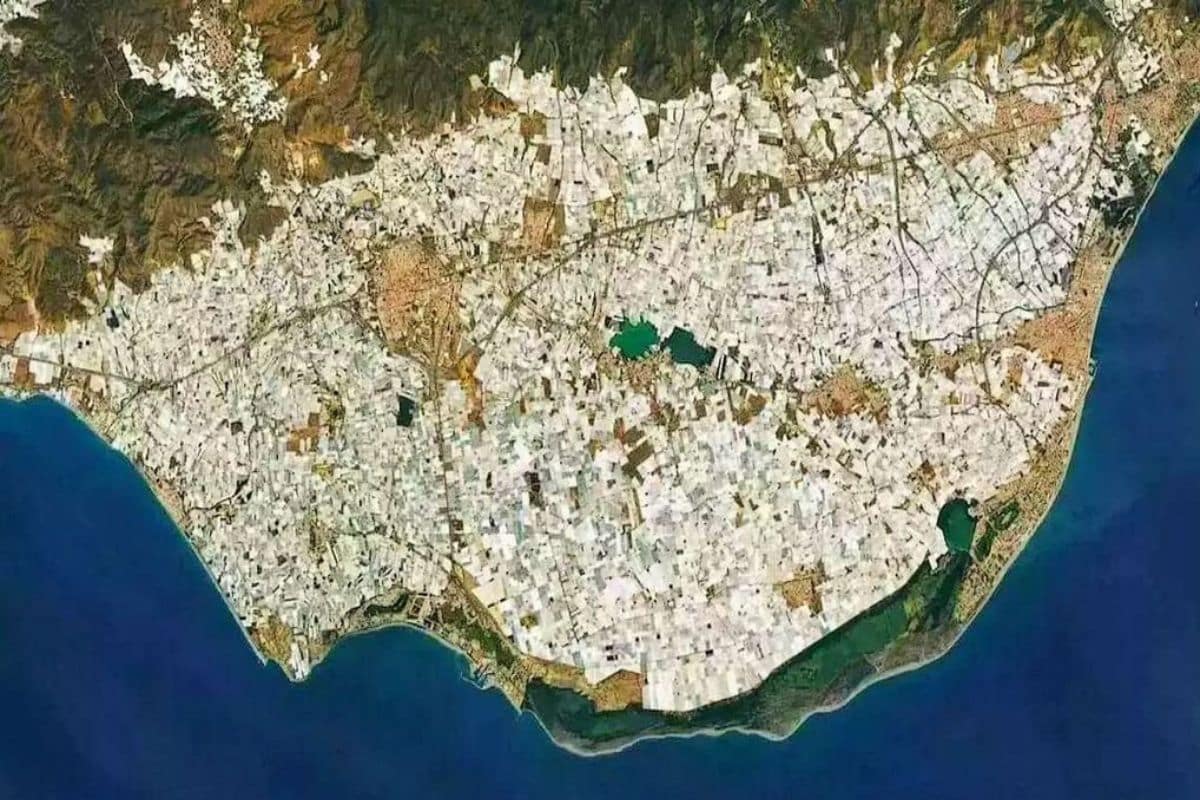
When astronauts aboard the International Space Station gaze down at Earth, they witness an intricate mosaic of natural formations and human achievements. Yet among all these features, one particular sight stands out with startling clarity : a brilliant white expanse in southern Spain that rivals any ancient monument in visibility. This isn’t a sprawling metropolis or a snow-capped mountain range, but rather an agricultural phenomenon that has transformed an entire province into one of the most recognizable landmarks from orbit.
Why this Spanish region outshines ancient wonders from space
Contrary to popular belief, neither Egypt’s pyramids nor China’s Great Wall can be easily distinguished by the naked eye from space. The honor of being Europe’s most visible human-made structure belongs to something far more contemporary and unexpected : the greenhouse complexes of Almería province. Located in southeastern Spain along the Mediterranean coast, this region has become a brilliant beacon visible from hundreds of kilometers above Earth’s surface.
The phenomenon began modestly in the late 1950s when entrepreneur José Hernández Buj experimented with Belgian-inspired greenhouse designs in this arid landscape. What started as a simple solution to hostile growing conditions has evolved into an agricultural powerhouse covering more than 40,000 hectares. The structures’ reflective plastic roofs create such a striking contrast against the surrounding terrain that satellites capture them with remarkable ease, and astronauts consistently report them as among the most distinctive human-made features visible from the International Space Station.
Spanish astronaut Pedro Duque, who served as Minister of Science and Innovation, once noted that this area represents one of Europe’s most remarkable sights when viewed from orbit. The sheer reflectivity of the white plastic coverings produces a luminous patch that stands out far more dramatically than conventional architectural landmarks, regardless of their historical or cultural significance.
From barren desert to agricultural innovation hub
The transformation of Almería from semi-arid wilderness into a thriving agricultural center represents a remarkable convergence of natural conditions and technological advancement. The region’s consistent sunshine and favorable climate, combined with cutting-edge farming techniques, have created an environment where year-round production flourishes despite minimal rainfall.
This vast network of greenhouses employs sophisticated systems that maximize efficiency while minimizing waste. The following innovations have made this transformation possible :
- Precision drip irrigation systems that deliver water directly to plant roots, dramatically reducing consumption in this water-scarce region
- Advanced climate control mechanisms that maintain optimal growing temperatures throughout the year
- Integrated waste management programs that recycle organic materials and reduce environmental impact
- Sustainable certification programs that ensure responsible farming practices
The Campo de Dalías and El Ejido areas form the heart of this agricultural zone, where meticulous organization and planning have turned what was once considered marginal land into highly productive farmland. The region now generates between 2.5 and 3.5 million tons of produce annually, supplying European supermarkets with tomatoes, cucumbers, zucchini, and peppers even during winter months when local production elsewhere remains impossible.
The unexpected climate effect of Europe’s plastic sea
Beyond its visual impact from space, this enormous greenhouse complex produces an intriguing environmental phenomenon. The reflective surfaces don’t simply make the region visible from orbit; they also create a measurable cooling effect on the local climate. By bouncing solar radiation back into space rather than absorbing it, these structures have inadvertently modified temperature patterns in ways that continue to fascinate climate scientists.
| Aspect | Traditional farmland | Almería greenhouses |
|---|---|---|
| Solar reflection rate | 15-25% | 70-85% |
| Annual production capacity | Limited to seasonal cycles | Continuous year-round output |
| Water efficiency | Standard irrigation methods | Optimized drip systems |
| Visibility from space | Minimal | Highly distinctive |
This cooling phenomenon has sparked international interest among agricultural researchers seeking sustainable farming solutions for arid regions worldwide. While other areas have attempted to replicate Almería’s model, none have achieved the same scale or concentration. The region’s success stems from its unique combination of geographical advantages, technical expertise, and decades of accumulated experience in intensive greenhouse cultivation.
Beyond vegetables : a global model for sustainable agriculture
The Almería greenhouse complex has evolved far beyond simple food production. It now represents a living laboratory where agricultural innovation meets environmental responsibility. Recent years have witnessed significant advances in reducing chemical inputs, implementing biological pest control methods, and obtaining internationally recognized sustainability certifications.
NASA Earth’s satellite imagery has documented the region’s evolution over decades, providing valuable data on how human agricultural activity can be monitored from space. These observations have proven useful not only for understanding land use patterns but also for developing strategies to maximize food production in challenging environments worldwide. The clear skies and innovative farming techniques have transformed what was once considered inhospitable territory into a major European food source.
While environmental concerns persist regarding resource consumption and ecological impact, the ongoing improvements in farming practices demonstrate that intensive agriculture and sustainability need not be mutually exclusive. The region continues to refine its methods, balancing productivity demands with environmental stewardship in ways that other agricultural zones increasingly seek to emulate.